
Why Your Video Pipeline Should Be Diffable: The Power of VideoJSON
July 8, 2026 · By VideoFlowLearn why moving from binary blobs to a diffable VideoJSON schema is essential for version control, programmatic video rendering, and scalable automation.
Why Your Video Pipeline Should Be Diffable: The Power of VideoJSON
Traditional video editing is a black box. Whether you are dealing with proprietary .aep files from After Effects or raw binary .mp4 exports, the history of a video asset is usually opaque. If a pixel changes, you can't see why in a pull request. You can't code-review a transition. You can't easily roll back a specific color grade without re-opening a heavy UI.
In modern software engineering, we treat everything as code—infrastructure, documentation, and logic. It’s time we treated video the same way. By moving from binary blobs to a portable, structured schema like VideoJSON, we unlock a new era of programmatic video rendering that is transparent, versionable, and highly scalable.
The Binary Problem: Why Opaque Assets Fail
When your video assets are stored as binary files, your development workflow hits a wall. Binary files are notoriously difficult to manage in version control systems like Git. They lead to repository bloat, merge conflicts that require manual resolution, and a total lack of visibility into what actually changed between versions.
Imagine a scenario where a marketing team wants to update the brand color across fifty different automated video templates. In a traditional pipeline, this might involve manually opening fifty project files or running complex, fragile FFmpeg string-concatenation scripts. There is no "Find and Replace" for an MP4.

VideoJSON: The Portable Source of Truth
At the heart of the VideoFlow ecosystem is VideoJSON. Unlike other solutions that tie your video definition to a specific UI or a heavy runtime (like React), VideoFlow uses a fluent TypeScript builder to compile your scene into a plain, portable JSON document.
When you call $.compile() using the @videoflow/core builder API, you aren't just generating a temporary state; you are producing a serializable source of truth. This JSON contains every layer, every keyframe, every GLSL effect, and every transition preset in a structured format that any language can understand.
import VideoFlow from '@videoflow/core';

const $ = new VideoFlow({ width: 1920, height: 1080 });

// Constructing a scene that compiles to VideoJSON
const title = $.addText({
  text: 'Diffable Video',
  fontSize: 8,
  color: '#FF5A1F', // Our brand orange
  position: [0.5, 0.4]
});

title.fadeIn('600ms');
$.wait('3s');

const json = await $.compile();
// Now you have a portable VideoJSON object
console.log(JSON.stringify(json, null, 2));
Because this is just JSON, you can store it in a Postgres JSONB column, cache it in Redis, or—most importantly—commit it to Git. When you change that color hex code or adjust the fadeIn duration, your Git diff shows exactly what happened. Your video pipeline becomes as maintainable as your CSS.
The Multi-Renderer Advantage
A major benefit of a portable schema is that it decouples the definition of the video from the execution of the render. In our guide to the three official renderers, we explore how the same VideoJSON can be handled by different environments:
- Preview: Use
@videoflow/renderer-domfor a frame-accurate, 60fps live preview in your web app. - Client-side Export: Use
@videoflow/renderer-browserto let users export MP4s directly in their browser via WebCodecs, saving you thousands in server costs. - Headless Batching: Use
@videoflow/renderer-serverin Node.js to generate thousands of personalized videos on a schedule.
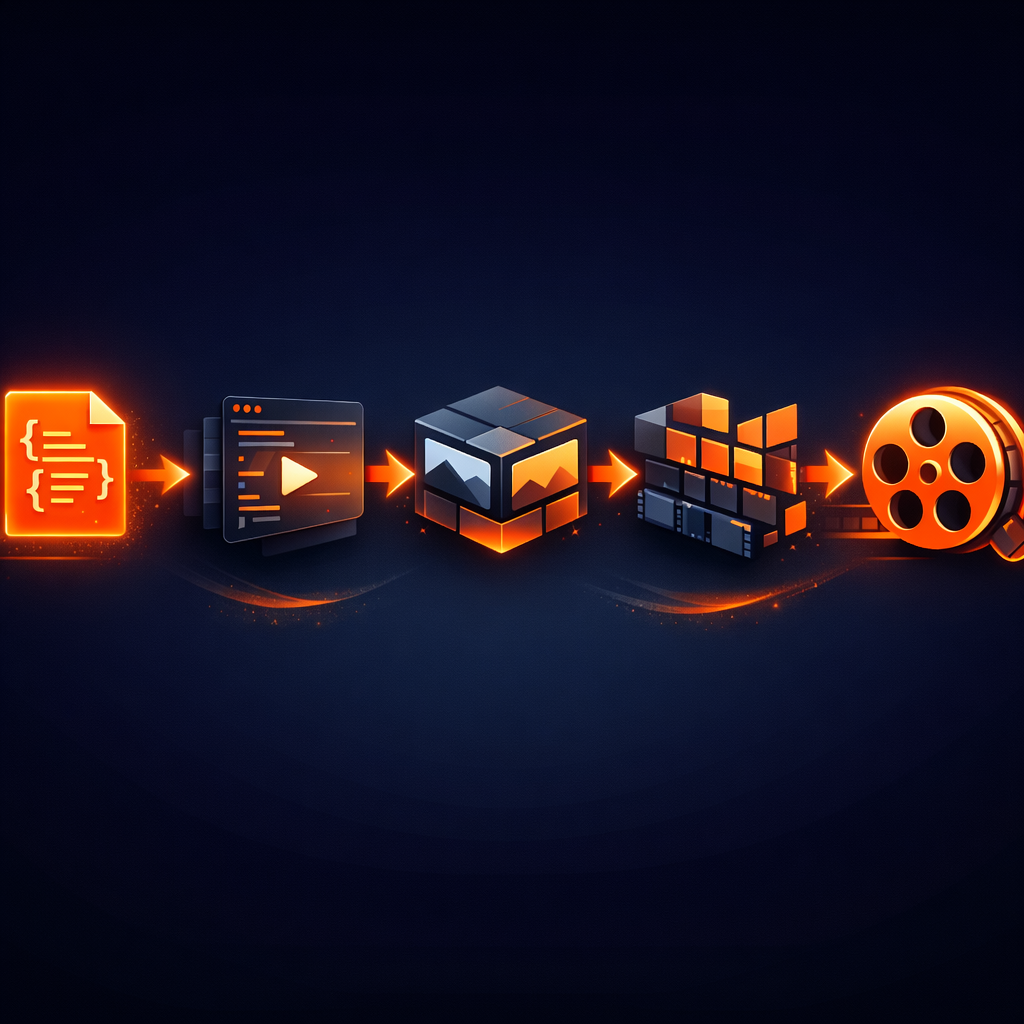
This portability is why we often argue that LLMs need structured VideoJSON rather than raw code. It is easier for an AI agent to emit a valid JSON schema than to manage complex React component lifecycles or FFmpeg flags.
Programmatic Video Rendering at Scale
When your videos are diffable, they become part of your CI/CD pipeline. You can run automated tests to ensure that a change in your core library doesn't break the layout of your generated videos. You can use "visual regression" testing on your VideoJSON output to catch unintended shifts in timing or positioning.
This approach is particularly powerful for SaaS companies building personalized video features. Whether you are generating weekly recap videos for users or automated product demos, having a diffable, version-controlled template system ensures that your automated content factory remains stable and predictable.
How VideoFlow Handles This
VideoFlow was built from the ground up to prioritize this "JSON-first" philosophy. The @videoflow/core package (Apache-2.0) focuses entirely on turning your intent into a valid VideoJSON document. It doesn't care if you are rendering on a Lambda function or in a Chrome tab—it just cares that the math is right and the schema is valid.
By using standardized transition presets like blurResolve or glitchResolve and GLSL effects like chromaticAberration, VideoFlow ensures that the resulting JSON is concise. We don't embed heavy assets; we reference them, keeping the "source code" of your video lightweight and easy to manage.
Conclusion: Stop Sending Blobs, Start Sending Data
Moving to a diffable video pipeline isn't just about technical elegance; it's about developer velocity. When you treat your videos as data, you enable your team to collaborate more effectively, automate more aggressively, and scale without the overhead of traditional binary asset management.
Ready to see what VideoJSON looks like in action? Head over to the VideoFlow Playground to build a scene and inspect the compiled JSON output in real-time. If you're ready to start building, check out our Quick Start guide or dive into the source on GitHub.
Your video pipeline shouldn't be a mystery. Make it diffable.